
What's in canned Chicken Stock anyways?
Food means different things to each one of us. Food itself has a history imbedded in medicine, politics, and socio-cultural structures. Food is unique to each locality, country, region, as it is unique to each individual. If food is necessary as subsistence and also to society in the above aspects, then why is it that the average American does not recognize the ingredients in our food labels? Although globalization has circulated the benefits of cheaper foods with lower prices worldwide, the U.S. still reigns among country with the poorest diets for the average citizen. Particular structural and historical conditions in the U.S. in comparison to other countries like China make the U.S. more prone to consuming narcissistic diets.
Americans do not see food in the same light as the Chinese do. The availability of many foods to the Chinese opens up a way to rebel against Maoist coercions that historically restricted citizens to a diet of cabbage, coupon bought flower, and occasional slices of pork to maximize the work productivity and enforce proletariat simple lifestyle (Farquhar 55). The consuming of a diverse range of foods makes for the growing middle class Chinese in the 1990’s (Farquhar 50) to be better connected with the world. However, this historical significance does not explain the significance differences of the view of food between the East and the West. Like the Chinese, Americans have a range of different foods available- in fact we are coined as the “melting pot!” “The melting pot” is manifested in the diversity of foods we have in local markets and restaurants.
 Chinese soups for hunger and health
What continues to happen in China is the reminder of how food functions not only as what we eat daily, but also as the backbone of healing and restoration of the body’s imbalances. The Chinese medicine has always promoted awareness of natural herbs, minerals, and animal products to aid in healthcare practices. Today, resources such as books are readily available and categorized by the illness and symptoms patients could experience. These books are comprehensive and have been noted for having homely advices for types of foods with nutritional and medicinal benefits (Farquhar 51). Individuals are more tempted to be better in tuned with their bodies for preventive healthcare measures. The usage of exotic creatures and the organs of small to large, reptile to mammals and even primates (“The Heart of the Dragon: Eating”) make the medicinal diets of China less of a challenge for locals to obtain the foods compared to places that consider such foods to be too “foreign.” Even though globalization gives the Chinese freedom to consume foods from elsewhere with less dietary, nutritional, and medicinal properties, there has already been a firm cultural identity of healing linked to the usage of natural products that were available within the country.
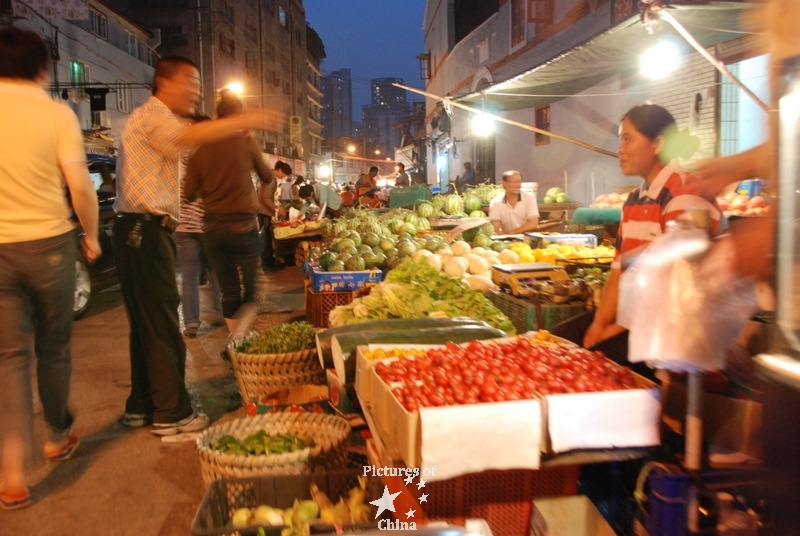
Locals bargaining for lower prices at a Shanghai nightmarket
Food is linked to “choice” and “individual” freedom. A wide selection of food is “Democratic,” especially in America. Food should be fast and easy. More time should be devoted to other things besides being in the kitchen. Both American men and women strive to be “productive” as many women work to add income to the contemporary family household struggling to survive in a feeble economy. Fast food restaurants were quick to fill in this niche in the economy. Not only are fast foods, delicious, consists of the grains, vegetables, and meat, but they are also highly affordable. Compared to China, the U.S. is not as lenient in providing a large selection of healthy, raw foods with accommodating prices. The advantages of bartering for everything from foods to clothing, makeup, and etc. help the Chinese to seek out healthier foods that may require more preparation but cost less. Two other cultural factors aid the Chinese to have better diets than the Americans. Firstly, there are not gender roles associated with cooking as the skills to cook are prized for both men and women. Secondly, because of value of cooking, the time spent cook is valuable because younger children learn to cook from observing their parents and family members (“The Heart of the Dragon: Eating”). The cost of fuel and the cramped kitchen corners of the families in China encourage Chinese families to make family meals (Farquhar 53). With families more concentrated on dining together, it is only natural for the families to try to incorporate healthier, medicinal, and dietary foods into the meals.
Analogies about the mundane experiences of life can be described by the humors of Chinese medicine. “Bitterness” can describe the weather, the individual experience of hardships, and the political state of the country (Farquhar 62). Food interconnects so many aspects of Chinese life. In America food interconnects with life on more of personal level. Food advertisements also work as preventive measures against ailments and diseases. Unfortunately, even though we connect to food on a personal level, Americans’ lack of understanding of what we eat feed into the demise of our health. What we eat is better connected to the insecurities we have about our individual beings since most of us are not too comfortable with revealing the foods we consume to our healthcare providers. The culture of “medicinalization” and supplements has always been an alternative to changing eating habits.


Commericialization of a popular item eventually sets up the item to be manufactured in other forms.
Health, beauty, fitness, attractiveness equate to slimness. Slimness is not only for the self to be proud about, but to also elicit sex appeal. With a combination of cultural demands for productivity, the road to slimness should be fast and easy as how fast foods are. Due to our lack of nutritional and dietary knowledge, including the inconvenience of food preparation, Americans tend to only know about the highly advertised nutritional benefits of a small selection of foods. This helps to explain why how common foods become so popularized in media- if the benefits of these foods do not “shock” people then they would not be so highly advertized. The initiation of a type of food into the media automatically sets the food into an experimental course of mixing extracts of the particular food into other common items to boost sales. We tend to not distinguish between the nutritional benefits of processed and foods in their raw form. Americans are also encouraged to equate benefits of foods in raw form with processed or canned foods because of economic and storage life reasons. Many people also have the option of resorting to frozen fruits and vegetable, including precooked frozen meals that seem to match the foods required for consumption by the food pyramid. Our investment to become healthy can make us vulnerable as we come to accept advertisements as truth and fact.

Fast foods continue to gain attention from advertising salads alongside burgers and other high calories foods. As the “leading proponents of fresh vegetable consumption,” fast foods restaurants are a “form of material culture and as a rhetorical force…plays a crucial role in dissemination of meaning: affirming, reinforcing, and transforming cultural beliefs and values (Retzinger 150).” The common saying that “we are what we eat” is materialized by media culture in general. This relation between consumption and ourselves is imminent in commercials that seek to promote health and fitness through milk. Such commercials aim towards women when the shape of a woman’s body dissolves into the hourglass shape glass of milk with a measure tape around the smallest diameter of the glass. Salads and vegetables are generally advertised with the focus on each individual ingredient being “fresh” with droplets of water, bouncing across the screen. Advertisement in America seems to inhibit more capitalistic motives than in China. Both consumers and marketers do not have the same prioritized values enforced by cultural history. It can be argued that China is moving in this particular direction as more and more Western and foreign foods enter the market in China.
 Can we give up our shiny apples for health? Don't the pretty qualities of these apple resemble qualities we desire for ourselves?
Do we value cheap and convenience over health? This question touches upon the issues of how well we treat our bodies and the bodies of people providing such conveniences for affordable prices. Although we are well aware about how damaging pesticides could be to the immigrant fruit and vegetable harvesters, how better do we treat bodies in America? The Pesticide Data Program has reported that ‘most likely foods to contain residues of high risk pesticides are apples, pears, peaches, grapes, green beans, tomatoes, peas, strawberries, spinach, peppers, melons, lettuce, and various juices (Retzinger 150).” The above produce constitutes much of the types of fruits and vegetables the average Americans consume to be healthy. Apples and grapes are among the three most favored fruit trinity: apples, oranges, and grapes. The choice to eat fruits and other foods that are presumed to be healthy without the consideration of pesticides fall into accordance with the marketable motto of ‘making smart menu choices is a snap’ and it is ‘cool,’ ‘smart,’ ‘colorful,’ ‘fun,’ and ‘easy.’ Making the smart menu choices is easy until the American consumer has to materialize actual healthy menu choices. Healthy comes to be mean buying “organic” and expensive foods. Healthy could also come to mean buying “locally” grown foods to ensure that they were not from an exploitative immigrant market. Healthy, could also mean changing from red meats to eating poultry and fish, and for some no meat at all. Majority of Americans cannot firmly believe that eating better foods is a healthier choice if the market itself does not care about the value of our health. Demands could be made, but suppliers have to carry the supply. Food shouldn’t define class differences and income levels. Foods shouldn’t also be used as a vehicle to perpetuate gender stereotypes. The many ills foods are associated with in the U.S. projects the idea that food choice not just an individual choice. Greater institutional forces create rules that view the individuals as commodity. Our health and body are valued on the same plane as commercial products and our bodies become second priority.
Sources
Farquhar, Judith. 2002. Medicinal Meals. In Appetites: Food and
Sex in Post-Socialist China. Durham: Duke University Press. Pg 47-77.
Jean, Retzinger. 2008. The Embodied Rhetoric of "Health" from Farm Fields to Salad Bowls.
Kennard, David. 1988. The Heart of the dragon. Episode 3, Eating. New York, N.Y.: Ambrose Video Pub. [distributor].
Sources of Images listed in Order Presented
Downs, Martin. 2008. The truth about 7 food Addictives. 3 July 2009. http://binkis.wordpress.com/2008/09/07/the-truth-about-7-common-food-additives/.
SoupRoast Pork Soup with Chinese Herbs.
<http://heartandhearth.blogspot.com/2008/07/roast-pork-soup-with-chinese-herbs.html>.
Nightmarket in Shanghai. 3 July 2009.
Ginseng and Ginseng Extract. 2009. 3 July 2009. <http://www.mdidea.com/products/proper/proper005.html>.
Vitality Herbal Tea 25 bags. 3 July 2009 <http://www.goodnessdirect.co.uk/cgi-local/frameset/detail/661949_Qi_Ginseng_Vitality_Herbal_Tea_25_bags.html>.
Sweet Medicine Essentials. 2007. Anti-aging Skincare. 3July 2009. <http://sweetmedicineessentials.com/antiaging-skincare-c-4.html>.
Glass of Milk. 3 July 2009. <http://www.jilbertdairy.com/content.asp?PageName=Index>.
General Store Merchandise. 3 July 2009. <http://www.applebarncidermill.com/product_detail.cfm?pid=162&cid=25>.

No comments:
Post a Comment